
JA-180PB
Service Manual for JA-180PB
Wireless PIR and Glass Breach Combined Detector
This product is a part of the Jablotron 100 series alarm system. The sensor contains two independent detectors (it learns at 2 addresses in the central unit). A PIR sensor is used to detect movement of the people. The breaking of glass surfaces that are the part of the monitored area is detected by changes in air pressure and characteristic sounds of glass breaking. The detector is intended for indoor use, communicates via the wireless and secure Jablotron protocol and is powered from a battery.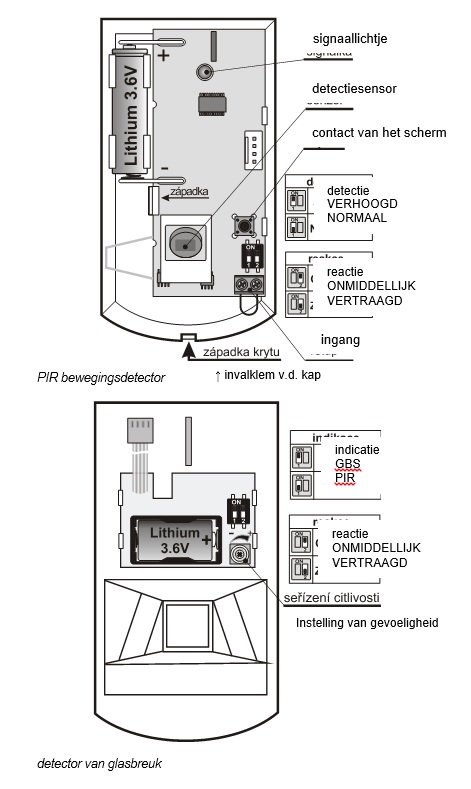
Installation
This product must be installed by a trained technician with valid manufacturer's certificate. The detector can be installed on a wall or in a corner of the room. Within the field of view of the PIR sensor, there should be no objects that rapidly change temperature (electric heaters, gas appliances and the like), no objects with temperature approaching human body temperature that move (e.g. wavy curtains, warmed by a radiator or the sun) and no pets. It is not recommended to install the detector opposite windows or reflectors.
There should be no mouths of ventilation, fans or other sources of air pressure changes or intense noise near the glass break detector. There should also be no sources of vibration or blows/hitting in the room to be monitored.
There should be no obstructions in front of the detector that obstruct its view and it should not be installed near metal objects (these overshadow radio communication).
Attention: the most common cause of unwanted activation of the detector is an incorrectly selected location. The detector should not be turned on to monitor when people or animals are moving in the room. When mounting, do not touch the PIR sensor inside the detector.
1. Open the detector cover (press the snap clip) and disconnect the cover module cable (glass break detector)
2. Take out the module of the PIR detector - is held by the drop-in clamp
3. Push through the holes for screws in the plastic backplane (at least one screw should be in the segment for detection of unplugging assembly)
4. Screw the plastic back panel in place, about 2.5 m high from the floor (vertically, with the cover drop-in clamp down)
5. Replace the PIR detector module (with the sensor facing the cover's collapsing clamp)
6. Leave the battery disconnected and the cover open. Continue according to the installation manual of the central unit (receiver). Basic steps:
a. Switch the central unit to service and switch to learning mode with the key 1
b. On the PIR detector, connect the battery - this will cause the PIR detector to start learning
c. On the glass break detector, connect the battery and then connect its cable to the plate of the PIR detector - thereby the detector will learn at the next free address (learn the glass break detector only after the PIR is learned)
d. End the learning mode with the # key
In order to comply with the EN 50131-2-2 standard, the cover's drop-in terminal must be secured by the supplied screw.
If you are going to learn the detector in the receiver after the batteries have already been connected, as first disconnect both batteries, then press and release the cover contact (the residual energy is used up) and only then run the learning mode.
After connecting the batteries, the detector needs approx. 2 minutes for stabilization. During this time, its signal light remains permanently on.
Adjustable switches of PIR module
Switch 1: determines the degree of immunity against false alarms. Position OFF combines good immunity with fast response. Position ON increases the immunity of the sensor at the expense of speed (to be used in problematic installations).
Note that the most common cause of unwanted activation is improper detector placement.
Switch 2: DEL/INS determines whether the detector is located on the access route to the house and provides an exit and entry delay = position OFF. In the ON position, the detector invokes an immediate response from the armed control center. The switch is meaningful only when used with the Jablotron central unit with set response natural. If a different response is set in the detector's central unit, or you are using the detector with a JA-182N or JA-180N receiver, the switch has no meaning.
On opening the cover, the detector always responds with a tamper signal.
Adjustable switches of the glass breaking module
Switch 1: determines, what will be displayed in the test mode by the signal light and the system - the movement or breaking of glass (see Detector testing). The switch affects the behavior of the detector only 15min. after closing its cover.
Note: although both detectors are in one housing, they operate independently. Each is learned for its own address and for each its own reaction can be set (by switches or setting of the control center)
Switch 2 determines the way of reaction to activation of the glass break detector. In the OFF position, the system provides a walk-in and walk-out delay (delayed response is recommended if the detector is installed near the entrance door). In the ON position, detector activation triggers an immediate alarm.
The switch is meaningful only when used with the Jablotron central unit with set response NATUR. If a different response is set in the detector central unit, or you are using the detector with a JA-182N or JA-180N receiver, the switch has no meaning.
Detector testing
For 15 minutes after closing the cover, the signal light indicates activation of the detector selected by the PIR / BMS switch. The control center allows checking signals from detectors in service mode, including measurement of their quality.
Switch 1
- in the ON position a short flash of the signal light indicates the air pressure change (blow against the glass), a long flash the alarm due to breaking of the glass (transmission to the control center).
- in the OFF position, a short flash of the signal light indicates a detected movement (beginning of analysis), a long flash the alarm (a long flash is also indicated if the glass was broken).
Glass breakage detector testing and setting:
- Hit with a suitable tool or by hand in a protective glove one after the other against all glass surfaces in the room to be monitored (so that the glass is noticeably deformed, but not broken)
- After glass deformation (pressure change in the room), the detector must react with a short flash of the light (switch must be in the GBS position).
- Sensitivity to pressure changes can be set by the trimmer on the module in the cover (clockwise increases sensitivity - an unnecessarily high sensitivity shortens battery life).
- The complex operation of the detector can be checked by the GBT-212 tester. This generates the sound of breaking glass after a blow against the glass.
- If there is an automatic device in the monitored area that emits sound (air conditioning, heating, fax, cooling units etc.) check that the glass breakage detector is not triggered by this activity.
Detection characteristics PIR sensor
From the factory, the detector is equipped with a 120°/12m lens. The room is monitored by 3 fans (curtain fields) - see the following figure.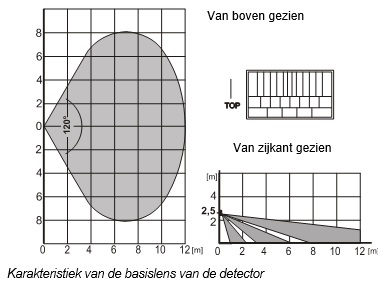
Characteristics of the detector's base lens
Characteristics can be changed by using an alternative lens: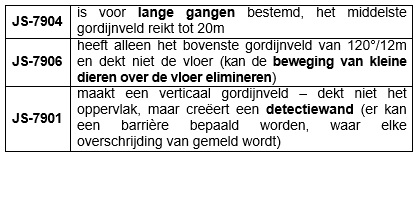
JS-7904 is intended for long corridors, the middle curtain field extends up to 20m
JS-7906 has only the upper curtain field of 120°/12m and does not cover the floor (can eliminate the movement of small animals across the floor)
JS-7901 creates a vertical curtain field - does not cover the surface, but creates a detection wall (a barrier can be defined, where any violation of it is reported)
Note: after replacing the lens, check if the detector covers the area properly (an incorrectly installed lens can cause a detection error).
Select sleep period of 5 minutes / 1 minute for the PIR sensor
15 minutes after closing the cover, the PIR sensor goes into power saving mode. If it detects a movement, it informs the control center and for the next 5 minutes it does not respond to the movement (sensor sleeps). After this period, the sensor wakes up and continuously monitors until the next movement in the room, etc.
The sleep period of the sensor can be shortened to 1 minute by pressing the contact switch of the cover when connecting the battery of the PIR detector (if you connect the battery without pressing the cover switch, the sleep period will be set to 5 minutes).
The glass breakage detector is ready to report alarm at any time.
Auxiliary input for wires
The input can be used, for example, for the magnetic door/window detector. The activation (opening of the terminals) has the same effect as the movement for the detector.
The wire connected to the terminals may be up to 3m long, it is recommended to use a shielded cable.
If the input is not used, the terminals must be jumpered.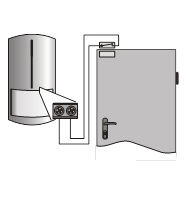
Detection characteristics of the glass breakage detector
The glass breakage detector has almost spherical detection characteristics. Thus, it is able to detect the breaking of glass up to 9 m, see the following figure (the glass area must be at least 60 x 60cm - for smaller windows, the detection distance will be shorter). The condition for proper operation is that the glass surface forms the shell of the enclosed space, in which the detector is installed. The detector responds to the breaking of all types of glass, including the glass fitted with a laminate film.
Please note that the detector is not able to flawlessly detect the cutting of an opening in the glass by a glass cutter. Therefore, it is recommended to monitor the valuable objects directly behind the glass with a motion detector.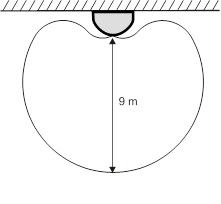
Range characteristic of the detector - seen from above or side
Replace batteries in the detector
The product contains 2 batteries and continuously checks their status. If they become weaker be detected, the user is informed (possibly also the service technician). The detector continues to work and also indicates movement by a short flash of the signal light. We recommend replacing both batteries within 2 weeks of the notification. The batteries are replaced by a technician in service mode. After the batteries are replaced, the sensor needs approx. 2 minutes for stabilization - its light remains on. After replacing the batteries, test the operation of both sensors (you can select which detector is displayed by the signal light through the PIR / BMS switch for 15 min. after closing the cover).
If a weak battery is inserted in the detector, its signal light will flash for approx. 1 min. After that, the detector will work, but will report a depleted battery.
Do not dispose of a used battery in the household waste, but dispose of it with chemical waste.
Removing detector from the system
The system reports any loss of detector. Therefore, if you intentionally disassemble a detector, it must be deleted from both respective addresses in the control center.
Technical parameters
Power supply PIR section lithium battery type LS(T)14500 (3.6V AA / 2.4Ah)
Power supply BMS section lithium battery type LS(T)14250 (3.6V ½ AA / 1.2Ah)
Typical battery life approx. 3 years (PIR sensor sleeps 5min.)
Communication band 868.1 MHz, protocol Jablotron
Communication range approx 300m (direct visibility)
Recommended installation height 2.5m above floor
Detection angle / detection coverage PIR sensor 120° / 12m (with base lens)
Detection distance glass breakage: 9m (glass min. 60 x 60cm)
Environment according to CSN EN 50131-1 II. indoors, general
Operating temperature range -10 to +40 °C
Dimensions, weight 110 x 60 x 55 mm, 120 g
Classification cf. CSN EN 50131-1, CSN EN 50131-2-2, CSN EN 50131-5-3
grade 2
to CSN ETSI EN 300220, CSN EN 50130-4, CSN EN 55022,
CSN EN 60950-1
Conditions of operation CTÚ VO-R/10/06.2009-9
The detector has been designed and manufactured in accordance with the provisions to be applied thereto: Government Decree No. 426/2000 Sb. if used according to its intended use. Original declaration of conformity can be found at www.jablotron.cz in the advice (support) section.
Note: Although this product does not contain harmful materials, do not dispose of it in the household waste, but dispose of it at the collection point intended for electronic waste.